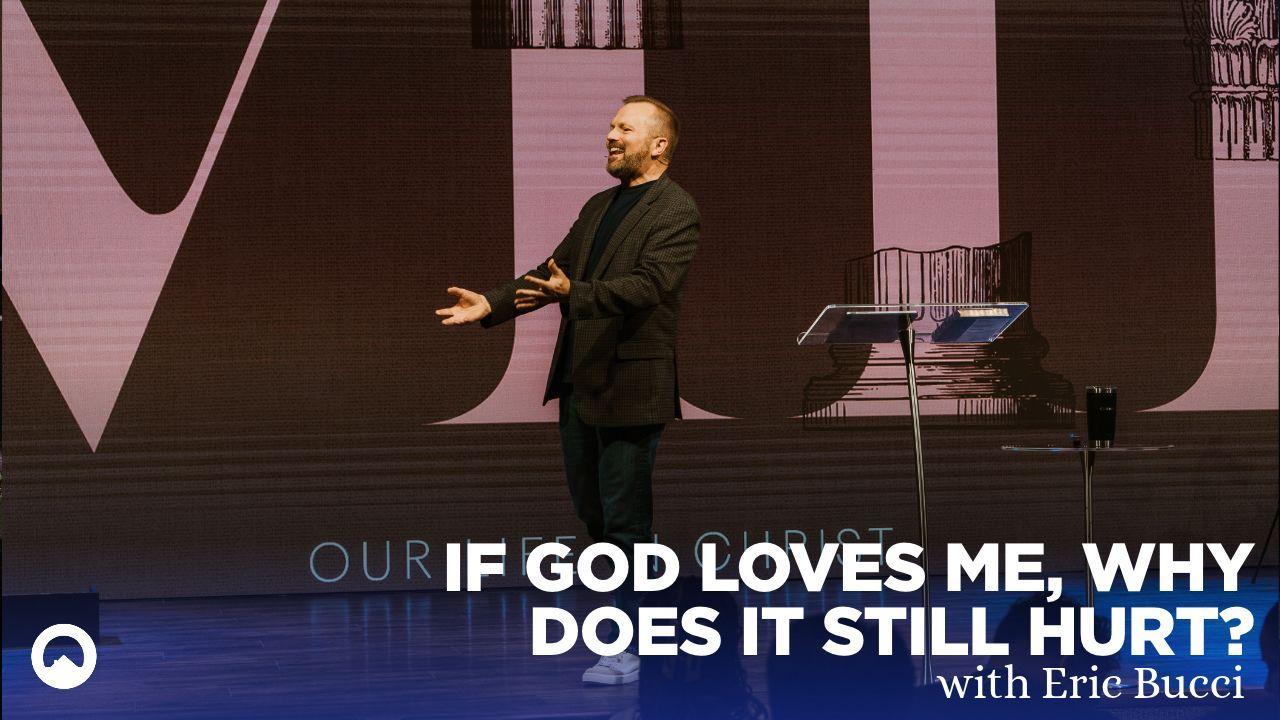
Christians aren't promised a life without struggle
Many of us grew up with the idea that if you're a Christian, you should never be sad. Smile, say you're doing great, and if you're not, there must be sin in your life. That message has done real damage. When you're hurting and church feels like a place where you have to pretend, the last thing you want to do is go.
Jesus said something different: "These things I have spoken unto you, that in me ye might have peace. In the world ye shall have tribulation: but be of good cheer; I have overcome the world" (John 16:33). Peace is not the absence of anxiety, depression or fear. You don't need peace when nothing is wrong. Jesus offers peace precisely because, on this side of heaven, suffering is part of being human.
Even the Christmas story — so calm on the nativity set — was full of fear: a pregnant teenage girl who could have been stoned, a bewildered Joseph, a king slaughtering children, a family fleeing to Egypt. That's why the angels kept saying "fear not." In the middle of the chaos, God came. And pain isn't wasted. Most of us can look back and see that we grew the most in our hardest seasons, the way muscles grow when they're stretched.
Jesus understands what you're going through
Jesus knows what anguish feels like. In the Garden of Gethsemane He told His disciples His soul was overwhelmed with sorrow to the point of death, and Luke records that "being in an agony he prayed more earnestly: and his sweat was as it were great drops of blood falling down to the ground" (Luke 22:44). On the cross He cried out, "My God, my God, why hast thou forsaken me?" — the deepest separation and hopelessness anyone has ever known, carried so that we never have to face it alone.
You are not a bad person because you are struggling. God doesn't run away from pain; He goes through it with you.
In charismatic, Spirit-filled churches that believe God heals, mental health can be treated like leprosy — no one wants to talk about it. Pastor Eric asks: we don't judge people for wearing glasses or taking thyroid medication, so why judge someone whose brain chemistry needs help? We believe God still heals, and we also believe every good and perfect gift comes from Him — including doctors and medicine. If you need medication, that's okay. Some people are over-prescribed and some under-prescribed, and grief after a divorce or a death is normal and needs to be felt, not numbed. But needing help is never a failure of faith.
Mental health is never just one thing
In Scripture, "mind" means more than the brain. It describes the whole inner person — thoughts, will, emotions and spirit. Western culture tends to put each part of us in its own silo, but they are all connected: what happens in your body affects your soul, and what is in your spirit flows into your soul and body.
Who we are is shaped by nature (our genetics), nurture (how we were raised and what we've lived through) and pneuma, the spirit. Pastor Eric names four contributors to mental health struggles:
Social — what you're facing: a lost marriage or job, bills you can't pay, isolation. We were made for community, and screens and synthetic relationships can't replace real people in a real room.
Spiritual — your relationship with God, the foundation everything else is built on.
Psychological — your makeup and the thought patterns you've practiced.
Biological — sleep, diet, exercise and chemistry.
So if you're struggling, start with the basics: see your doctor and get a physical. Check your blood pressure and glucose. Get outside and walk. Eat regular meals, and go to bed and get up at the same time. If you're still struggling, you may have a chemical imbalance — find a good doctor or psychiatrist. Just don't neglect your spirit.
Renewing your mind
Romans 12:2 says, "be not conformed to this world: but be ye transformed by the renewing of your mind." Research on neuroplasticity shows our brains keep forming new pathways at any age. The thoughts we repeat grow stronger: what you look at long becomes strong, and what you feed leads. Your subconscious can't tell a lie from the truth, so the lies we rehearse during the day seep in at night.
That's why Scripture tells us to bring "into captivity every thought to the obedience of Christ" (2 Corinthians 10:5). Pastor Eric suggests becoming an investigative reporter about your own emotions. When you feel anxious, ask why, when and how. Sometimes, as with generalized anxiety, there isn't a clear reason. But often there is, and you can't heal what you won't name. Then ask: am I going to listen to my feelings or to the truth? I feel alone — but God says He will never leave me nor forsake me.
Philippians 4:6–7 gives a pattern: "Be careful for nothing; but in every thing by prayer and supplication with thanksgiving let your requests be made known unto God." Supplication means telling God in detail what you're going through. Thanksgiving is one of the strongest protections for the mind — honest prayer that says, "Lord, I don't know what's going on, but You do." Then fill your mind with whatever is true, noble and of good report (Philippians 4:8). What you listen to and watch matters.
And know who God is. "There is no fear in love; but perfect love casteth out fear: because fear hath torment" (1 John 4:18). God is not waiting for you to get yourself together before you come to Him. He is slow to anger, abounding in love, and for you, not against you. "For God hath not given us the spirit of fear; but of power, and of love, and of a sound mind" (2 Timothy 1:7). In Christ, you have the mind of Christ.
You weren't meant to carry this alone
First John 4 connects loving God with loving one another. Mental health isn't separate from community; community is part of it. Generations ago, families lived and ate together and churches were woven into daily life. Today we drift from place to place. Put down roots. Be connected to God and to each other.
No single sermon can solve the mental health crisis, and this one doesn't try to. But there is healing, hope and a new beginning in Jesus. If you're struggling, tell someone: a friend, a pastor, a doctor. Our pastors would be honored to pray with you.
If you are in crisis or thinking about ending your life, please call or text 988 to reach the Suicide & Crisis Lifeline (in the U.S.), or call 911. You matter to God, and you matter to us.
Key Scriptures
These things I have spoken unto you, that in me ye might have peace. In the world ye shall have tribulation: but be of good cheer; I have overcome the world.
For God hath not given us the spirit of fear; but of power, and of love, and of a sound mind.
And be not conformed to this world: but be ye transformed by the renewing of your mind, that ye may prove what is that good, and acceptable, and perfect, will of God.
Be careful for nothing; but in every thing by prayer and supplication with thanksgiving let your requests be made known unto God. And the peace of God, which passeth all understanding, shall keep your hearts and minds through Christ Jesus.
Casting down imaginations, and every high thing that exalteth itself against the knowledge of God, and bringing into captivity every thought to the obedience of Christ.
There is no fear in love; but perfect love casteth out fear: because fear hath torment. He that feareth is not made perfect in love.
Questions to Reflect On
- Have you ever felt you had to hide a struggle at church? What would it take for you to let someone in?
- Of the four contributors — social, spiritual, psychological and biological — which needs the most attention in your life right now?
- What thought have you been rehearsing that isn't true? What does God's Word say instead?
- What is one practical step you could take this week: a doctor's visit, a walk, a regular bedtime, or a conversation with a friend?
Wrestling with this? You don’t have to do it alone.
Our pastors would love to pray with you, answer your questions, or just listen.